History of women pilots. Woman pilots and aviation history.
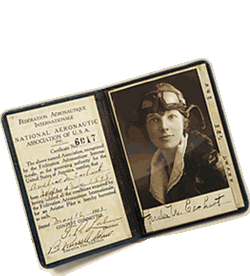
In 1784, before America even had its first president, Madame Thible ascended as a balloon passenger in Lyons, France. In 1909 French Baroness Raymonde de Laroche tried flying - a Voisin Biplane. She learned to manipulate the unstable and unpredictable machine and became the first woman licensed to fly by the Federation Aeronautic Internationale. She was killed in an airplane crash in 1919.
Tiny Broadwick, in 1908 at age 15, became the first person to make a parachute jump from a hot air balloon. She made close to a thousand jumps from balloons while traveling with a carnival and then later demonstrated parachuting from aircraft to the U.S. Army.
In the early days of aviation there were several firsts by women. Bessica Raiche built her own airplane in her living room then flew it on Sept. 16, 1910. Blanche Stuart Scott took up flying with the famous Glenn Curtiss, becoming a member of his exhibition team. He declared her America's first aviatrix on Sept. 6, 1910, though she never obtained a pilot's license.
Harriet Quimby was officially the first with a license obtained from the Moisant School in 1911. Fellow student Mathilde Moisant became number two and later established an altitude record of 1,500 feet. Harriet Quimby traveled to France where she acquired a Bleriot monoplane to attempt a flight across the English Channel. She had no opportunity to flight-test the aircraft and handled a compass for the first time above the fog in the Channel. She returned to America successful and triumphant. Only three months later she died in the unstable Bleriot over Boston harbor.
Katherine Stinson learned to fly in 1912, becoming famous for precision acrobatics and sky-writing. The much-admired Ruth Law was a cohort of Katherine's, becoming an expert exhibition flyer and record holder. She established an American long-distance record flying solo from Chicago to New York.
And an African-American woman, against staggering odds, gained renown in aviation. Bessie Coleman, facing race and gender discrimination, found the door locked at flying schools. So she studied French and sailed for Paris to learn to fly. She returned in 1921, the world's first licensed African-American pilot. "Brave Bessie," as she became known, became a popular attraction on the air show circuit. For some unknown reason, at an air show in 1926, Bessie had failed to wear her parachute and hadn't strapped herself in. A wrench jammed her controls. As the airplane rolled over, Bessie fell to her death.
The early years exacted a horrendous toll on aviation's pioneers. We can hardly comprehend the machines they called airplanes. Nevertheless more eager aviators followed and aviation grew up with women pilots.
By 1929 there were over 100 American women (and numerous women in other countries) licensed to fly. A Women's Air Derby was launched that year in conjunction with the Cleveland Air Races. The rules were straightforward: whoever got to Cleveland in the least time won! The entries were divided into two classes, depending upon size of engine. The starting point was Santa Monica, flying across the continent to Cleveland. The most famous names of the day were in the lineup, with Will Rogers on hand at the takeoff. He remarked that the start looked like a "powder puff derby." Louise Thaden claimed first in the faster aircraft division with her Travel Air J-5 and Phoebe Omlie was first in the second division.
After all had arrived in Cleveland, Amelia Earhart, Gladys O'Donnell, Ruth Nichols, Blanche Noyes, Phoebe Omlie and Louise Thaden gathered under the grandstand and, at the suggestion of Phoebe Omlie, considered forming some kind of organization just for women pilots. They sent out an organizational letter to all of the licensed women pilots in the United States. On Nov. 2, 1929, 26 women met and chartered an international organization of women pilots known as the Ninety-Nines.
Other female pilot groups sprang up also. Five of the '29 Air Derby participants met at the home of Gladys O'Donnell in Long Beach and formed the Skylarks. Opal Kunz, disappointed that the 99s had not gone in the direction of her desire for a tightly-disciplined group dedicated to national defense, formed the Betsy Ross Corps in 1931. The objective was to be of service to the country through humanitarian relief work. Later, at the outbreak of WWII, Opal Kunz once again formed a women's defense program, this time called the Women Fliers of America. The group was devoted to training women pilots to replace men going off to war.
An offshoot of the Betsy Ross Corps came through Florence "Pancho" Barnes, who envisioned an unofficial division of the U.S. Amy Air Corps. The Women's Air Reserve evolved under Pancho's strong leadership and was quite successful. The Reserve served in several disasters including the Montrose Flood. They were undoubtedly ahead of their time, and aspects of their service later could be seen in the WASPs and the Civil Air Patrol.
Louise Thaden quickly achieved an altitude record, an endurance record and a speed record in a Beech Travel Air. In 1936 the all-male Bendix Trophy Race was opened to women. Louise, along with Blanche Noyes, flew to first place in a Staggerwing Beech. That year Louise Thaden was awarded the Harmon Trophy as the world's outstanding flyer.
Lady Mary Heath fought the bureaucratic battle in Britain for women who followed. She had passed her "A" license without difficulty, but when it came to the "B," permitting the carriage of passengers, the English Air Ministry was skeptical about entrusting passengers' lives to a woman. Finally, a committee studied the question of physical tests for women pilots, and the athletic Lady Heath accomplished the breakthrough.
American socialite Ruth Nichols became a flying addict, flying dirigibles, gliders, auto gyros, seaplanes, amphibians and four-engine aircraft. She held three different world records at one time and an early transport license. Not content with transcontinental record flights, Ruth aspired, along with Laura Ingalls and Amelia Earhart, to solo the Atlantic.
As thoughts of war couldn't be avoided, Ruth became convinced that airplanes could play a prominent role as air ambulances. Ruth founded Relief Wings, whose purpose was a humanitarian air service in case of either civilian disasters or war. After the outbreak of WWII, Ruth turned the basic structure over to the Civil Air Patrol.
On Dec. 27, 1938, President Roosevelt authorized the CAA to train 20,000 private pilots a year in the nation's colleges. The program was called the Civilian Pilot Training program, and its purpose was twofold: to stimulate aviation's growth and to build up a reserve of pilots to which the military might turn. The CPT program was a huge success, and many women pilots learned to fly under the auspices of CPT, or taught in the program.
War clouds were gathering and the first to respond with a call for pilots was England. The British were desperate for civilian pilots to ferry aircraft from factories to aerodromes to free the military pilots to fly combat. The Air Transport Auxiliary was formed. As the needs grew, so did the service, with additional women soon flying all 120 types of aircraft flown by the RAF. Hazards were very real. All aircraft observed radio silence so en route weather was not available. Dodging artillery ranges, barrage balloons and training aircraft made navigation circuitous.
At the outbreak of WWII the Tennessee Bureau of Aeronautics decided to aid the war effort by training a select group of women as flight instructors, replacing the men gone to war. They borrowed former Tennessean Phoebe Omlie from the CAA to set up and supervise the program. From 235 applicants, 10 girls were chosen, trained and graduated to teach flying.
During this time, two prominent women aviators, Jacqueline Cochran and Nancy Harkness Love, recognized the role that women could assume in time of war. Each pursued the military use of civilian women pilots. On Sept. 10, 1942, the Air Transport Command announced a plan to utilize women pilots would be called WAFS, Women's Auxiliary Ferrying Squadron. Nancy Love was appointed squadron commander.
Male and female pilots from other countries flew for the ATA, and Jacqueline Cochran recruited approximately 25 American girls to serve. One of the first was Helen Richey, who later resigned, then joined the WASP. Nancy Miller (Livingston) from California flew from July 1942 - July 1945. Nancy flew 50 different types of British aircraft across England, into Europe, Scotland and Ireland. Each woman flew as captain with no co-pilot because of the pilot shortage.
In 1942 Betty Huyler became one of the original group of 25 women forming the WAFS (Women's Auxiliary Ferrying Squadron) organized by Nancy Harkness Love. They ferried aircraft for the Army Air Corps within the continental limits of the United States. The organization later became the WASPs. During the war years, Betty ferried fighters and bombers, transports, cargo and utility aircraft.
The first group of 25 went to Wilmington, DE and consisted of experienced pilots who would need only to transition into the military airplanes they would be flying. Betty Gillies became the first WAFS member; Cornelia Fort it's second.
Cornelia had been a flight instructor teaching a student in Honolulu on Dec. 7, 1941.
She described what happened:
- "Coming in just before the last landing, I looked casually around and saw a military plane coming directly toward me. I jerked the controls away from my student and jammed the throttle wide open to pull above the oncoming plane. He passed so close under us that our celluloid windows rattled violently, and I looked down to see what kind of plane it was.
- "The painted red balls on the tops of the wings shone brightly in the sun. I looked again with complete and utter disbelief. Honolulu was familiar with the emblem of the Rising Sun on passenger ships but not on airplanes.
- "I looked quickly at Pearl Harbor, and my spine tingled when I saw billowing black smoke. Still, I thought hollowly it might be some kind of coincidence or maneuvers, it might be, it must be. For surely, dear God...
- 'Then I looked way up and saw the formations of silver bombers riding in. Something detached itself from an airplane and down, down and even with knowledge pounding in my mind, my heart turned convulsively when the bomb exploded in the middle of the harbor. I knew the air was not the place for my little baby airplane, and I set about landing as quickly as ever I could. A few seconds later a shadow passed over me and simultaneously bullets all around me.
- "Suddenly that little wedge of sky above Hickam Field and Pearl Harbor was the busiest, fullest piece of sky I ever saw.
- "We counted anxiously as our little civilian planes came flying home to roost. Two never came back. They were washed ashore weeks later on the windward side of the island, bullet-riddled. Not a pretty way for the brave little yellow Cubs and their pilots to go down to death."
As a nucleus of experienced pilots started flying successfully, Jacqueline Cochran's idea of training lower-time pilots and introducing them into the WAFS was adopted. As young women graduated from the training program, they would join the ranks of the Ferry Command. Miss Cochran's training program commenced in Houston and was designated the Women's Flying Training Detachment or WFTD. Four classes went through training, contending with such unmilitary problems as housing, transportation, no mess hall, and clothing. They had come to Houston to fly for their country and they worked hard. Halfway through the fourth training class, the whole operation was moved to Sweetwater, TX. The WAFS and WFTD were merged into one organization called WASP, Women's Airforce Service Pilots. Miss Cochran was named Director of Women Pilots. Mrs. Love continued as WASP Executive of the Ferrying division of the ATC.
Dependence upon the WASPs grew, and they flew everything the U.S. built. By 1944, WASPs were the only ferry pilots flying the P-47 Thunderbolt out of the Republic factory.
The WASP program was certainly successful. Safety and reliability were excellent and the freeing of male pilots made the program a valuable one for victory. Civilians Barbara Erickson (London) and Nancy Love received the Air Medal, and Jacqueline Cochran received the Distinguished Service Medal.
Jacqueline Cochran's credentials and fame had been established solidly before the war. Yet she went on to fly a Northrop T-38 jet and break every speed, altitude and distance record for women. She won the Bendix Race, set innumerable records and has been a multiple Harmon Trophy winner. She served the 99s as president.
By the 50th anniversary of the 99s (1979), the WWII Women's Airforce Service Pilots (WASP), gained veteran status for their wartime efforts. Women took their places in the cockpits of national airlines. With the exception of the Marine Corps, the military services opened their ranks to women pilots. Women were selected as astronaut candidates, held key positions in aerospace advertising and marketing and sales, and worked as engineers, scientists, lawyers and leaders in important aviation research and development projects.
Women became employed in highly technical civilian and government positions. By 1979, more than 5 percent of air traffic controllers were women. Women also were employed as Air Safety Investigators with the National Transportation Safety Board.
In the 1930s, Helen Richey was the first woman airline pilot. By 1979, 110 of the 45,000 airline pilots were women. It was perhaps unimpressive on the large scale, but a giant step for women in the industry. At that time, Kim Goodwin, age 22, was the youngest female member of a major air carrier flight crew.
Leading the way to space in 1963 was Valenhtina Tereshkova, a Russian woman. For U.S. women, 1979 proved to be a banner year in NASA's space program. From a field of 35 highly qualified female astronaut candidates, six women were selected by NASA as mission specialists for assignments on future crews. Among these women were 99s, adding to achievements in aviation as well as being noted as history-makers within the organization.
The year of 1983 was the 200th anniversary of manned flight, and the first space flight of a U.S. woman astronaut, Sally K. Ride. Though many 99s were making tremendous strides in aviation, events of 1983 were overshadowed by Sally's flight.
As part of the International Forest of Friendship celebration, 99 Lucile M. Wright honored Hideko Yohoyama, the first licensed woman pilot in Japan. The ceremony was held in Tokyo upon the completion of United Airlines' inaugural flight to Japan.
On Dec. 26, 1986, American Airlines Flight 412 departed with an all-female flight crew. Dr. Angela Masson was the first woman to fly as captain in the left seat of a Boeing 747.
In a symbolic move, astronaut Dr. Linda Goodwin carried Louise Thaden's flying helmet into space. But Dr. Goodwin was not the only woman in space this time. Rhea Seddon, Memphis Chapter, was aboard the space shuttle Columbia.
The list of firsts continued for 99s and women achieving in aviation. Patty Wagstaff was the first woman pilot to win the prestigious title of U.S. National Aerobatic Champion. For Patty, this would be one of many titles to her credit. Patty Wagstaff, Alaska Chapter, made history again in 1993 when she won the title of U.S. National Acrobatic Champion for the second year. She went on to place third at the International Acrobatic Club championships.
Making 99 and U.S. military history, 1st Lt. Jeannie Flynn became the Air Force's first female pilot. She flew the most advanced tactical fighter aircraft, the Strike Eagle F-15E. 2nd Lt. Sarah Deal was selected as the first female Marine pilot. Naval Officer Shanon Workman became the first aircraft carrier pilot. CPT. Kathy McDonald of the Texas Air National Guard became the first female fighter pilot to graduate from the Guard's six-month F-16 air combat training school at Kingsley Field.
Setting records, hot air balloonist Jetta Schantz, Florida First Coast Chapter, achieved an altitude record. Jetta exceeded the previous record of 32,572 feet by 1,272 feet, and brought her total national records to 18.
The year 1995 began with Eileen Collins, the first female shuttle pilot, taking off from Kennedy Space Center for a joint American-Russian space mission. Watching the launch were the 13 women who had passed the astronaut physical exams 34 years before.
August 1995 saw several events commemorating the triumphs, sacrifices and heroism during World War II. To mark the 50th anniversary of VJ Day, 120 planes flew across the U.S. to salute air veterans of WWII. As part of the honors, Barbara London, the only woman awarded the Air Medal during WWII, was one of 60 women honored at a USO dinner and dance in Long Beach Hangar. The commander of a squadron of women ferrying new planes to airfields nationwide, she won the medal after making four transcontinental flights in five days. The Planes of Fame Museum in Chino, CA, honored Women Airforce Service Pilots (WASPs) who were drafted into civilian service to ferry war planes east to be shipped overseas. American women pilots flew more than 60 million miles during the war. More than 30 women pilots were killed, yet it wasn't until 1977 that they were finally granted veteran status and benefits.
January 29, 1996, marked another anniversary - it had been 10 years since the space shuttle Challenger blew up soon after launch, killing all seven astronauts on board, including Judith Resnick and Christa McCauliffe. In March, Shannon Lucid became an official crew member of the Russian Mir space station. Lt. Sarah Deal became the first female Marine Corps pilot commanding a combat helicopter, the Super Stallion CH53E.
Adapted from:
"The Ninety-Nines 1929-1979" By Gene Nora Jessen originally published in 1979 as part of History of The Ninety-Nines, Inc. (with special appreciation to Melba Beard, Glenn Buffington, Virginia Thomas, Ruth Rueckert and many other 99s and friends.)
"Reaching for the Eighties and Beyond," from The Ninety-Nines, Yesterday-Today-Tomorrow, published in 1996.
"June 1995 - 1996," from The Ninety-Nines, Yesterday-Today-Tomorrow, published in 1996 originally excerpted from the annual report by Lynn Houston, international Historian, and from reports in The International Women Pilots Magazine/99 News
Adapted by: Jason Jorski