History of women pilots. History of the 99's.
By 1929 there were over 100 American women and numerous women in other countries licensed to fly. A Women's Air Derby was launched that year in conjunction with the Cleveland Air Races which the women were not allowed to enter. The rules were straightforward. Whoever got to Cleveland in the least time won! The starting point was Santa Monica across the continent to Cleveland. At takeoff Will Rogers remarked that the start looked like a "powder puff derby." Louise Thaden claimed first in the faster aircraft class with her Travel Air J-5, and Phoebe Omlie was first in the second division.
Despite the competitive nature of these talented women, or probably because of it they felt their camaraderie called for a more formalized bond. After all had arrived in Cleveland, Amelia Earhart, Gladys O'Donnell, Ruth Nichols, Blanche Noyes, Phoebe Omlie and Louise Thaden gathered under the grandstand and, at the suggestion of Phoebe Omlie, considered forming some kind of organization just for women pilots. An organizational letter went out to all the licensed female pilots in the United States. Of the 117 licensed women pilots in the country, 86 responded to the call.
On Nov. 2, 1929, 26 women gathered at Curtiss Airport, Valley Stream, NY. The women conducted their business in a hangar as the work of the mechanics proceeded around them. Tea was served from a tool box wagon on wheels. Club eligibility and purpose were quickly decided upon. Membership would be open to any woman with a pilot's license, and the purpose was "good fellowship, jobs and a central office and files on women in aviation."
Choosing a name was a little harder. Amelia Earhart and Jean Davis Hoyt proposed the name be taken from the sum total of charter members. Thus the group was momentarily the 86s, then the 97s and finally the Ninety-Nines.
The name/number stopped at 99, but the membership thereafter grew worldwide. Opal Kunz became acting president until a formal election could be held. Neva Paris, who was in charge of the election, was killed while en-route to air races in Florida leaving the meetings in disorder. Members pulled in opposing directions and officers were not finally selected, leaving the club informally structured. Louise Thaden served as secretary for several years and Blanche Noyes as treasurer, until Amelia Earhart became the group's first elected president in 1931.
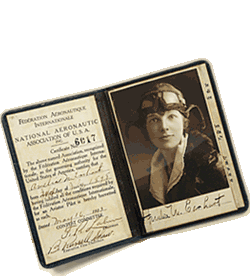
Amelia Earhart was to become the most famous woman pilot of all time, but in 1929 she was but one of a dozen daring female aviators. Amelia had flown the Atlantic as a passenger, gaining fame and adulation. In 1932, she realized her dream of crossing the Atlantic alone, for which she reaped international honors, and other record flights followed. Amelia was a strong advocate of awakening women's potential. She encouraged young girls to dream big, and said about women and aviation: "The more women fly, the more who become pilots, the quicker will we be recognized as an important factor in aviation." Ninety-Nines who knew her remember her as a warm and feminine person and a catalyst for achievement. Her parting words to Louise Thaden were, "If I should bop off, it'll be doing the thing that I've always most wanted to do."
The Ninety-Nines have always been an international organization. Jessie Keith Miller, an Australian, competed in the '29 Women's Air Derby and attended the first 99s organizational meeting on Long Island. A German, charter 99 Thea Rasche, was for several years the only woman in her country with a pilot's license and a plane of her own. Quotable Thea offers the sage advice, "Flying is more thrilling than love for a man, and far less dangerous."
Another German woman, 99 Hanna Reitsch, is recognized even today as the world's first and foremost female test pilot. Her firsts are astounding - first woman to fly jet planes, rocket planes and helicopters, the first pilot to fly a glider over the Alps, and the only woman to fly a robot V-I, commonly known as a buzz bomb, modified for pilot control. During WWII, Hanna tested all types of military planes for the Luftwaffe. Into the 1970s, this remarkable woman remained in the top ranks of glider and helicopter pilots.
Other international 99s have gained worldwide fame. Nancy Ellis Leebold built up time and experience ferrying war surplus aircraft across Australia after WWII. Then she made a 12,000-mile flight from Britain to Australia in a single-engine Miles Messenger. The 145-hp aircraft had only one four-channel, short- range VHF transceiver, so the flight was accomplished by dead reckoning with a war surplus magnetic compass.
Brazil produced Ada Rogato, who in 1951 flew her 90-hp Cessna 25,000 miles solo across the Andes, to Alaska and across Canada and the United States. The Dean of South America's flyers, Anesia Pinheiro Machado, also made a grand tour in on a goodwill flight from New York to Rio de Janeiro. She was a pioneer pilot of Brazil, and has been recognized by dozens of governments and aviation organizations.
Britain produced daring and colorful women pilots in the early years, exemplified by Amy Johnson Mollison, who flew solo from Britain to Australia in 1930 in an open cockpit biplane, taking 19 days for the task. In 1966 Sheila Scott became Britain's first pilot to fly around the world solo, doing so in a Piper Comanche 260. After her round-the-world flight, Sheila went on to other record-breaking dashes. She set a number of new records flying from London to Cape Town. For these flights she was awarded the Britannia Trophy, the highest award of the Royal Aero Club of the United Kingdom. Sheila had been preceded by an Irish pilot named Lady Mary Heath, a charter 99. She had solo-ed her Avro Avian on the Cape Town to London route, a treacherous flight in 1928.
In 1935, 99s Helen Richey, Louise Thaden, Helen MacCloskey, Nancy Love and Blanche Noyes were appointed as air marking specialists for the CAA. Their assignment was to produce a marking sign every 15 miles along a given route. Through attrition the group diminished to one, Blanche, and the job was reversed during WWII; signs were to come down to thwart any enemy aircraft.
By 1979, The 99s had grown to 164 chapters, including two in South Africa. Membership had grown to over 5,000 members. On Nov. 2, 1979, the 99s celebrated their golden jubilee in New York. Over 600 members attended the festivities
The 99s also were celebrating other aviation achievements. Susan Horstman, Kansas Chapter, started classes to be the first woman to fly for National Airlines. Angela Masson of the Golden Triangle Chapter, who was flying for American Airlines, was in the process of upgrading to a DC10. She was the first woman assigned to a jumbo jet. Jerrie Cobb, the first woman to complete Lovelace Clinic's astronaut tests, received the International Harmon Trophy. The trophy, presented by the president of the United States, was awarded for her previous 14 years of dedication, service and humanitarian flights to the people of the Amazon basin. She was later nominated for the Nobel Peace Prize.
The 99s launched the new decade of the' 80s with an organization-wide media day. Each chapter was encouraged to spread the word about the mission and work of the 99s. In addition, the organization became a charter member of the World Aerospace Education Organization.
In 1981, Juanita Blumberg and Bonnie Quenzler won the Air Race Classic. Karen Cox was the first FAA-certified female flight navigator. Olive Ann Beech, known to many as "the first lady of aviation," was inducted into the Aviation Hall of Fame in Dayton, OH.
During the years, The 99s placed an emphasis on a "seek and keep" program, encouraging existing members to recruit and keep female student pilots, termed the "66" Program. Education, legislation and community service were ongoing 99 contributions.
The 99 Minnesota Lady Lifeguards, who flew much-needed blood to various locations, participated in Red Cross recognition day for Lifeguard flights. Hundreds of miles to the east, Patricia Blum, Greater New York Chapter, was impacting other lives in a positive way. She founded the Corporate Angel Network, helping to set up a means for cancer patients to fill an empty seat on corporate flights. By June 1984, she received a volunteer action award from President Reagan. Another humanitarian, Central Illinois 99 Wanda Whitsitt, founded a non-profit organization of private pilots named Lifeline. The organization was established to fly medical supplies, blood, organs and health personnel where needed, as well as to assist in disaster relief operations.
The year of 1983 saw the 200th anniversary of manned flight, and the first space flight of a U.S. woman astronaut, Sally K. Ride. Though many 99s were making tremendous strides in aviation, events of 1983 were overshadowed by Sally's ride. At the launch site, 99s watched with great interest and excitement. As the space shuttle lifted off the launch pad, 99s shared a surge of feelings fraught with pride, apprehension, anticipation and joy, along with millions of people around the world.
Ninety-Nines continued to break world records and make major contributions to the aviation world. Los Angeles businesswoman Brooke Knapp set a new around-the-world speed record in a Lear 35, circling the globe in 50 hours, 22 minutes, 22 seconds, shattering the previous record held by Hank Beard. The Air Force's first all-female transatlantic flight crew flew in a C-141 Starlifter.
1983 proved to be another year of celebrations. As part of the International Forest of Friendship celebration, 99 Lucile M. Wright honored Hideko Yohoyama, the first licensed woman pilot in Japan. The ceremony was held in Tokyo upon the completion of United Airlines' inaugural flight to Japan.
By March 1983 the 99s had grown to 5,900 members. In June, The 99s recognized Terry McCullough of the newly-formed Heart of Texas Chapter as the 6,000th member.
In 1984, one of the largest 99s convention was held in Anchorage, AK. Many 99s, including members from Finland, flew their own planes to Anchorage. The 99s were recognized at the national Aviation Hall of Fame in Dayton, OH, for 55 years of aviation contributions in the areas of general aviation and safety.
99s member Jeana Yeager and Dick Rutan completed a record-setting round-the-world journey of Voyager, traveling 25,012 miles without refueling. The flight began and ended at Edwards AFB in the Mojave Desert. Made of stiffened paper and plastic, the Voyager at times carried more than five times its weight in fuel. It took 9 days, 3 minutes and 44 seconds to complete the global flight.
The 99s moved into a new two-story headquarters building that housed the executive offices and museum facility, which included a premiere archive and resource library located adjacent to Will Rogers World Airport in Oklahoma City.
At summer's end, 99s shared in celebrating the 60th anniversary of the 1929 First Women's Air Derby with a commemorative flight of Louise Thaden's winning Travel Air from Santa Monica, CA, to Cleveland, OH. The restored 1929 Travel Air was flown by Airborne Captain Susan Dusenberry.
Chapters continued to be busy with community service events and programs. In Louisiana, the New Orleans Chapter developed and instituted an aerospace program to present in area schools. Members discussed careers in aviation, history, Civil Air Patrol programs and emphasized the importance of a high moral code of ethics and standards.
During Operation Desert Storm, the war in the Persian Gulf, the Arabian 99s gave unselfishly of their time by entertaining troops in their homes, raising funds for MASH units and helping recruit volunteers for the Red Cross.
The list of firsts continued for 99s and women achieving in aviation. MAJ Eileen Collins was selected by NASA as the first female shuttle pilot. Patty Wagstaff was the first woman pilot to win the prestigious title of U.S. National Aerobatic Champion. Wagstaff, from the Alaska Chapter, made history again in 1993 when she won the title of U.S. National Acrobatic Champion for the second year. She went on to place third at the International Acrobatic Club championships.
Evelyn Sharp, a charter member of the Nebraska 99s and an original member of the Women's Auxiliary Ferry Squadron (WAFS), became the first woman to be inducted into the Nebraska Aviation Hall of Fame. That year the U.S. Defense Department changed its policy, allowing women to fly combat missions.
Making 99 and U.S. military history, 1st Lt. Jeannie Flynn became the Air Force's first female pilot. She flew the most advanced tactical fighter aircraft, the Strike Eagle F-15E. 2nd Lt. Sarah Deal was selected as the first female Marine pilot. Naval Officer Shanon Workman became the first aircraft carrier pilot. CPT. Kathy McDonald of the Texas Air National Guard because the first female fighter pilot to graduate from the Guard's six-month F-16 air combat training school at Kingsley Field, Klamath Falls, OR.
Homecoming 1996, the 1996 convention, was held in Oklahoma City, so members could take the opportunity to visit International Headquarters.
At the fall 1995 Board of Directors meeting in Oklahoma City, the Board and Council of Governors developed the following mission statement:
- Promote world fellowship through flight
- Provide networking and scholarship opportunities for women and aviation education in the community
- Preserve the unique history of women in aviation.
Certainly The 99s' high visibility at the community level, working often quietly and without much fanfare, has helped women reach their aviation-related goals. It's been those honorable tasks such as air markings, pinch-hitting courses for non-pilot passengers, and educating both children and adults, that 99s have been recognized for their efforts.
Adapted from:
"The Ninety-Nines 1929-1979" By Gene Nora Jessen originally published in 1979 as part of History of The Ninety-Nines, Inc. (with special appreciation to Melba Beard, Glenn Buffington, Virginia Thomas, Ruth Rueckert and many other 99s and friends.)
"Reaching for the Eighties and Beyond," from The Ninety-Nines, Yesterday-Today-Tomorrow, published in 1996.
"June 1995 - 1996," from The Ninety-Nines, Yesterday-Today-Tomorrow, published in 1996 originally excerpted from the annual report by Lynn Houston, international Historian, and from reports in The International Women Pilots Magazine/99 News
Adapted by: Jason Jorski